
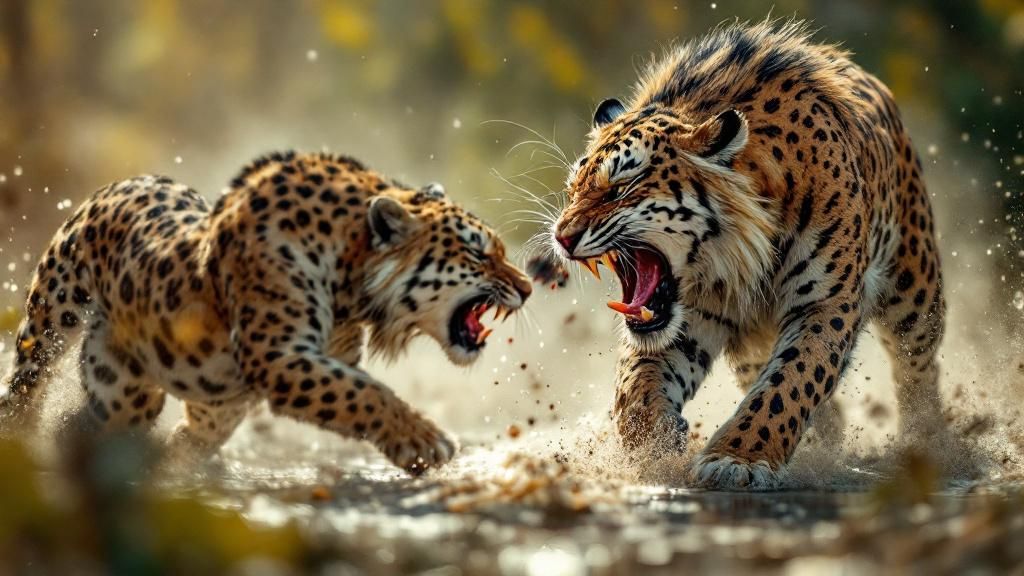
From the frozen Arctic to the heart of Europe’s cities, nature has delivered a striking collection of moments this week, capturing the imagination of wildlife enthusiasts and conservationists alike. A young Iberian lynx in Spain has earned international acclaim for its hunting abilities, whilst an unexpected visitor turned up browsing toy kangaroos in a Tasmanian airport. Meanwhile, conservationists are marking a pair of mountain gorillas delivered in the Democratic Republic of the Congo, a positive indicator for endangered species recovery. These encounters, stretching across continents from Canada to Cambodia, demonstrate both the resilience of wild animals and the urgent conservation issues facing our planet’s most vulnerable creatures.
Hunters and Hunted: The Circle of Life in Perspective
Nature’s most compelling moments often take place in the predator-prey relationship, and this week has provided stunning photographic documentation of the raw reality of life in the wild. Josef Stefan’s prize-winning photograph shows a juvenile Iberian lynx in Ciudad Real, Spain, undertaking the basic act of hunting—playfully tossing a small mammal into the air before making the kill. The image, which claimed the Nuveen People’s Choice award at the Wildlife Photographer of the Year competition, reminds us that below the surface of wildlife lies an harsh necessity. Every living being, however young, must master the skills required to survive in an increasingly difficult environment.
Beyond the Spanish lynx, various carnivores maintain their ongoing search across the globe’s diverse ecosystems. In the cold stretches of Cambridge Bay, Nunavut, an arctic fox’s white coat offers excellent concealment against the snow, where temperatures plummet to around -29°C in March. Meanwhile, in the warmer climates of Oregon, a ladybird—one of nature’s most effective natural predators—feeds on a roadside weed. Though small in stature, these beetles can consume dozens of aphids in a single day, playing a vital role in preserving environmental equilibrium. These encounters underscore how predation operates at every scale, from the massive lynx to the microscopic battles between insects.
- Iberian lynx demonstrates hunting methods in Spanish nature photography
- Arctic fox uses colour adaptation in extreme Canadian Arctic conditions
- Ladybirds control insect numbers through prolific aphid eating
- Wildlife Photographer of the Year celebrates predator-prey interactions worldwide
Unexpected Meetings: When Wildlife Comes Into Human Spaces
Whilst most animal photography captures creatures in their native environments, some of nature’s most entertaining instances occur when animals wander into decidedly human territory. These unexpected encounters remind us that the boundary between the wild and the developed world grows ever more indistinct, with wildlife adapting to urban and commercial environments in surprising ways. From airport hubs to riverside moorings, animals demonstrate impressive ingenuity in utilising the spaces we’ve created, often with results that vary between pleasing to troubling for both species involved.
Such intrusions highlight the intricate dynamic between human expansion and animal protection. When animals venture into shops, airports, and other public spaces, it frequently suggests either urgent need for food or mere inquisitiveness about new settings. These interactions, whilst occasionally inconvenient for humans, provide valuable opportunities to witness animal actions and strengthen the importance of coexistence strategies. Animal management teams and concerned citizens collaborate more frequently to securely transport displaced animals, converting risky encounters into educational moments.
The Peculiar Case of the Airport Possum
In a charming incident at Hobart Airport in Tasmania, a wild brushtail possum was spotted amongst toy kangaroos and dingoes in an airport gift shop—seemingly embarking on its own duty-free shopping expedition. The resourceful marsupial was carefully captured and relocated back to its original home, unharmed by its surprising shopping excursion. The possum’s brief stint as an chance retail visitor captured the imagination of airport staff and travellers alike.
The store’s staff members, enchanted by their furry visitor, voted on what to name the adventurous possum, converting a standard animal removal into a memorable community moment. This occurrence exemplifies how city animals can adjust to human spaces, looking for refuge or sustenance in unexpected locations. The possum’s successful relocation highlights the importance of swift, compassionate responses to such situations, guaranteeing both human safety and creature wellbeing.
- Brushtail possum found browsing in Tasmanian airport gift store
- Staff safely removed and relocated possum to the wild
- Airport community selected a name for the curious marsupial guest
Conservation Triumphs and Emerging Discoveries
Amidst escalating environmental challenges, recent ecological advances offer real cause for optimism. In the Democratic Republic of the Congo’s Virunga National Park, conservationists have celebrated the birth of twin mountain gorillas—a male and female pair—marking the second occurrence of twins in just a two-month period. This remarkable occurrence signals positive indicators about gorilla population health and breeding achievement within the park’s safeguarded limits. Such births are key achievements in species recovery efforts, particularly given the mountain gorilla’s traditionally vulnerable status. The repeated twin births demonstrate that comprehensive protection measures, combined with dedicated protection of essential ecosystems, can produce tangible outcomes in reversing population declines and establishing viable breeding communities.
At the same time, wildlife researchers have recorded troubling patterns affecting other species. The Wildlife Conservation Society has issued urgent calls for international action to protect striped hyenas, which face mounting threats across their range. With fewer than 10,000 individuals left worldwide and populations in steady decline, the species is classified as near threatened. Conservation efforts must reconcile safeguarding of remaining populations with habitat protection and human-wildlife conflict mitigation. These concurrent developments underscore the intricate terrain of modern conservation—where some species show promising recovery whilst others require urgent action to prevent further decline.
| Species | Conservation Status |
|---|---|
| Mountain Gorilla | Endangered (improving with recent twin births) |
| Striped Hyena | Near Threatened (declining globally) |
| Southern White Rhinoceros | Critically Endangered (relocation efforts ongoing) |
| Iberian Lynx | Vulnerable (recovering in Spain) |
Novel Species in Prehistoric Environments
Wildlife studies in Cambodia have yielded extraordinary discoveries within the country’s karst ecosystem. Researchers exploring Phnom Prampi cave in Battambang discovered a spectacular new pit viper species, characterised by its remarkable colouration and advanced predatory techniques. This extremely toxic serpent possesses heat-sensing organs located behind its nostrils, allowing it to track warm-blooded prey with accuracy in the cave’s darkness. The discovery constitutes just one of many newly identified species identified within Cambodia’s distinctive karst terrain, highlighting the region’s remarkable species diversity and evolutionary significance.
These findings highlight the importance of comprehensive species surveys in understudied areas. Ancient limestone caves and karst landscapes harbour species unique to these locations, constituting evolutionary laboratories where organisms have adapted to specialised environments over millennia. The discovery of new pit viper species alongside other organisms illustrates that thorough investigation continues to be vital for understanding global biodiversity. Such discoveries shape conservation strategies and increase scientific comprehension of evolutionary adaptation, particularly regarding how species adapt to harsh habitats to thrive and persist.
Evolution and Resilience: Nature’s Engineering Marvels
The living environment demonstrates remarkable ingenuity in how organisms have adapted to thrive within their specific environments. From the arctic fox’s pristine white coat providing camouflage against the icy Canadian terrain to the pit viper’s infrared sensing powers in Cambodian cave systems, evolution has crafted remarkable answers to survival challenges. These modifications embody millions of years of refinement, permitting species to inhabit ecological roles that would otherwise remain uninhabitable. The intricacy of such natural engineering—whether detection systems, protective colouration, or behavioural adaptations—showcases the natural world’s innovative potential and specialisation in response to pressures of the environment and resource distribution.
Smaller creatures prove equally resourceful in their approach to survival. Ladybirds, despite their diminutive size, act as nature’s pest control agents, eating numerous aphids each day and preserving ecological equilibrium within agricultural and wild ecosystems. Meanwhile, mallard hens show adaptive behaviour by choosing unusual nesting locations, such as moored rowing punts on the Thames, when natural habitats prove insufficient. These examples demonstrate how species throughout all size ranges—from minute evolutionary adjustments to adaptive behaviour—constantly adapt to changing circumstances, guaranteeing their continued existence in progressively unstable and landscapes shaped by human activity.
- Arctic foxes merge effortlessly into snow at conditions dropping to minus twenty-nine degrees Celsius.
- Pit vipers sense living prey using infrared heat sensors positioned behind their nostrils.
- Ladybirds eat large numbers of aphids each day, offering ecological pest management for ecosystems.
- Mallard hens adapt nesting behaviour by using artificial constructions like rowing boats.
- Iberian lynx develop hunting skills through playful prey manipulation before consumption.
Climate Challenges and Resilience
Climate extremes create formidable challenges to animal communities worldwide. In polar areas like Cambridge Bay, Nunavut, where temperatures plummet to −29°C during March, animal survival hinges on physiological and behavioural adjustments developed over generations. The arctic fox’s thick coat and streamlined form minimise heat loss, whilst adaptive behaviours such as den-dwelling and group hunting enhance survival prospects. These adaptations prove increasingly critical as global warming alters seasonal patterns, ice development schedules, and prey availability, forcing species to respond rapidly to unprecedented environmental shifts.
Conservation efforts increasingly recognise that protecting species requires safeguarding the ecosystems and climatic conditions upon which they depend. The relocation of southern white rhinoceroses to suitable habitats, such as Kidepo national park in Uganda, represents proactive intervention acknowledging habitat degradation and climate vulnerability. Similarly, the recent twin births of mountain gorillas in Virunga national park signal that species can recover when provided appropriate protection and stable environments. These conservation successes, though modest against global biodiversity challenges, demonstrate that strategic intervention combined with|strategic intervention paired with habitat preservation can help species navigate an increasingly precarious environmental future.
Moments of Calm: Creatures in Repose and Recreation
Amidst the intense battles for survival that characterise the natural world, quieter moments reveal wildlife engaging in everyday behaviours that underscore their exceptional ability to adapt. A mallard hen has established an unlikely sanctuary aboard a wooden rowing punt moored on the Thames at Henley, Oxfordshire, fashioning a protected nesting site beneath the gunwale where she now sits patiently on her eggs. This adaptive breeding strategy demonstrates how birds utilise human infrastructure to their advantage, transforming leisure vessels into safe havens during vulnerable breeding seasons. Similarly, a young hare has taken shelter in a field on Frankfurt’s outskirts, relying on concealment and immobility to avoid being spotted whilst remaining alert to possible dangers in its grassland habitat.
Play and learning represent vital elements of animal development, notably within predatory species refining hunting methods. An Iberian lynx captured in Josef Stefan’s award-winning photograph demonstrates this idea clearly, teasingly flinging a rodent upwards before catching and devouring it in Ciudad Real, Spain. Such activity, recorded by the Wildlife Photographer of the Year competition, demonstrates how developing carnivores refine skills crucial for independent survival. Even moments of apparent leisure—whether a brushtail possum’s interested examination of an airport shop in Tasmania or a ladybird foraging on verge vegetation—reveal the constant, purposeful engagement of creatures traversing their surroundings with exactness and natural ability.
- Mallard hens employ artificial nesting sites for breeding when natural sites prove inadequate or hard to reach.
- Young predators develop hunting proficiency through playful practice with captured prey items.
- Wildlife exhibits remarkable behavioural flexibility adapting to urban and modified environments.
- Camouflage and stillness stay essential survival techniques across various species and different habitats.
